


What does social responsibility actually mean?
Tough questions at CSR seminar in London:
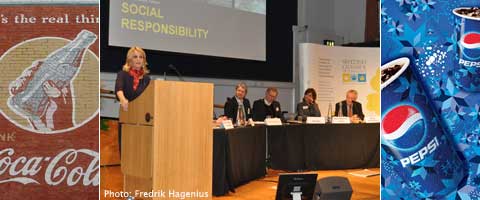
“When walking into a store, how do I know what is ethically right – if I should buy a Coca-Cola or a Pepsi?”
• How to boost sales with monkey management
• Why money doesn't motivate most workers
For the second year in a row, the Swedish Chamber of Commerce for the United Kingdom invited the business world to meet politicians in a panel discussion. This year’s theme was social responsibility (CSR) and the question of “Who is setting the agenda?”
“What does social responsibility actually mean?” asked moderator David Ibison at the beginning of the seminar and turned to the panellists. The question can be claimed to originate as a response to a fundamental principle stated by the American economist Milton Friedman in 1970’s; that corporations primarily have a responsibility towards their shareholders and not to the society as whole. This was an opinion that none of the panellists fully agreed with.
Instead, Caroline Hempstead, VP Corporate Affairs, AstraZeneca, on David Ibisons right side talked about the importance of doing something more than just producing pharmaceuticals, while David Reid, Chairman of Tesco, sitting next to her highlighted the importance of recycling and liability to consumers. But stepping away from the theoretical it suddenly became harder to sort things out.
“When walking into a store, how do I know what is ethically right – if I should buy a Coca-Cola or a Pepsi?” a person in the audience asked. Several of the panellists then agreed on the consumer’s responsibility for his or her own consumer behaviour, but had problems in giving a clear answer to the question.
However, the importance of consumers actually knowing what they buy seemed to be of great interest to both speakers and audience.
“Transparency within and around a company is crucial. Consumers need to know what they are investing in”, said Mårten Andersson, CEO of Skandia Nordic.
Jane Bateman, Department For Business, Innovation And Skills, highlighted the need of balance between engagement with stakeholders and transparency.
David Ibison’s question really got the discussion going, and the ambiguity of the CSR concept brought with it several interesting perspectives and comments.
“I think the fact that it is as hard as it is to define CSR is one of the most interesting things about the discussion today. The fact that it means different things to different people.” said Bengt Westerberg, President of The Red Cross.
Among the other speakers of today were also: Maria Borelius-Larsson Vice Chairman, Hand In Hand International, Will Day, Chair, Sustainable Development Commission, Dr Beatrice Engström-Bondy, Vice Chairman Of The Swedish Chamber Of Commerce For the UK, Lars-Olle Larsson Partner, PWC, Per Schlingmann, State Secretary, Swedish Prime Minister's Office and RT Hon Stephen Timms, Labour MP.
- - -
Published in collaboration with Swedish Chamber of Commerce for the UK.
Last Updated (Friday, 04 February 2011 11:27)


Latest Jobs for English speakers in Sweden

Jobs for English speakers in Sweden


Comments