


FIND EXCLUSIVE JOBS FROM €60,000

First woman to win Nobel Economics Prize
Elinor Ostrom and Oliver Williamson of the United States won the 2009 Nobel Economics Prize on Monday for their work on the organisation of cooperation in economic governance, the Nobel jury said.
| Related news: • List of Nobel Economics Prize laureates • Americans dominated the Nobel awards • The Nobel Prizes in numbers - thrilling facts • Last will and testament of Alfred Nobel |
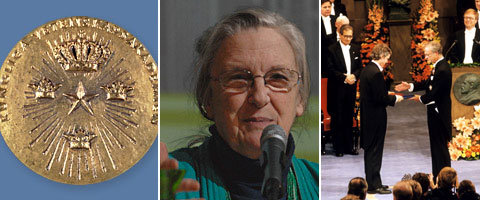
Elinor Ostrom is the first woman to win the Economics Prize, which has been awarded since 1969.
Their work may be seen as particularly topical in the wake of the global financial crisis and ongoing efforts to combat climate change.
"The research of Elinor Ostrom and Oliver Williamson demonstrates that economic analysis can shed light on most forms of social organisation," the jury said.
Ostrom, who describes herself as a political scientist and not an economist, won half the 10-million-kronor (1.42-million-dollar, 980,000-euro) prize "for her analysis of economic governance" especially relating to the management of common property or property under common control, such as natural resources.
Her work challenged the conventional wisdom that common property is poorly managed and should be either regulated by central authorities or privatised, the jury said.
A professor at Indiana University whose name has circulated as a possible winner in recent years, Ostrom told Swedish television her first reaction was "great surprise and appreciation," and said she was "in shock" over being the first woman to clinch the honour.
"If we want to halt the degradation of our natural environment and prevent a repetition of the many collapses of natural-resource stocks experienced in the past, we should learn from the successes and failures of common-property regimes," the jury said.
"Ostrom's work teaches us novel lessons about the deep mechanisms that sustain cooperation in human societies," it added.
She conducted numerous studies of user-managed fish stocks, pastures, woods, lakes and groundwater basins, and concluded that the outcomes are "more often than not, better than predicted by standard theories," the jury explained.
Last Updated (Monday, 12 October 2009 14:44)


Latest Jobs for English speakers in Sweden

Jobs for English speakers in Sweden


