


Swedish green-tech firm cleans up water quality
House of GreenTech is bringing Scandinavian clean-tech to the U.S.

Peter Selemark, president of the House of GreenTech.
• Swedish ecological burials attract world interest
• Obama’s ‘green plan’ boosts Swedish companies
The farm pond at Bar-T Mountainside was full of algae last week. This week, it's nearly clear. And not because owner Joe Richardson added chemicals to get rid of it.
Algae is controlled in many ponds by using chemicals, which isn't healthy for the water. Instead, Richardson bought an environmentally friendly electronic pump to pump oxygen into the water. The pump will need to work about four hours each day to keep the pond clear. The pond is about 150 by 50 feet.
The new equipment creates the right-sized bubbles, said Peter Selemark, president of the House of GreenTech, an Annapolis-based company that is bringing Scandinavian environmental technology to the U.S.
The pump was developed by Kurt Andersson, founder of Anlager, a small Swedish company that created the technology for use in golf courses and water treatment ponds in Sweden.
"The right size of air bubbles gives you a much better burst of oxygen in the water," said Stan Sersen, a LEED-certified architect working with House of GreenTech.
LEED stands for Leadership and Energy and Environmental Design, and the designation comes from the U.S. Green Building Council.
Surface algae typically forms if there's too much fertilizer in the water.
The bubbles cannot be too large.
"It's like champagne," he said. "The taste of really good champagne has just the right size bubbles."
Unlike other pond aeration devices, which are typically fountains, the pump takes air through a tube and mixes it with water.
Bar-T Mountainside is a children's camp and a corporate retreat center, located on the former Lawson Farm on Roderick Road. Part of the land is still being farmed.
Richardson is incorporating environmental practices into the camp. He had a windmill installed to provide electricity. He has also put in many erosion-control devices along the creek that flows by the property, with help from the Watershed Management Section of Frederick County, the Potomac Conservancy and other environmental organizations.
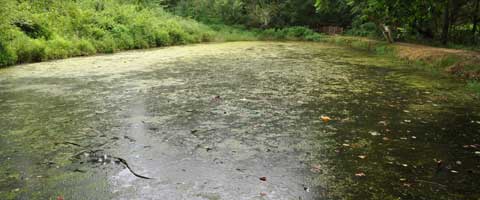
Before...
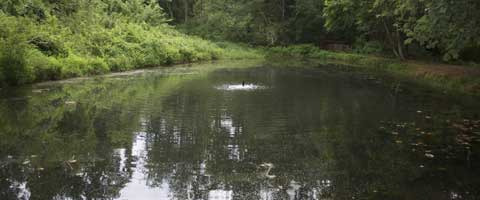
... 24 hours later.
The pump uses electricity. But it prevents algae from forming. Algae sucks the life out of water by removing the oxygen and forming a greenish scum. In a healthy body of water, whether it's a pond, a lake or a river, a small amount of algae is always present, but it's near the bottom, which allows other aquatic life to feed off it.
But when there's too much algae it forms across the top of the water and prevents sunlight and other nutrients from reaching phytoplankton, the tiny plants that form the basic food source for all aquatic life. Algae also prevents oxygen from entering the water.
Water from the pond flows into a creek known as the North Branch of the Monocacy River. Richardson said he will monitor the water quality in the creek to see if it improves.
The pump has a flotation ring around it to keep it just below the surface of the water. A small tube is visible above the water. Bubbles spreading across the pond indicate the system is working.
Andersson said the technology took about 15 years to develop. Selemark said it has uses not only for golf course ponds and water treatment systems, but also for farm ponds used to irrigate fields.
- - -
To see more of the Frederick News-Post or to subscribe to the newspaper, go to http://www.fredericknewspost.com. Copyright (c) 2010, The Frederick News-Post, Md. Distributed by McClatchy-Tribune Information Services.
Last Updated (Sunday, 08 August 2010 20:59)


Latest Jobs for English speakers in Sweden

Jobs for English speakers in Sweden


